Monday, 25 October 2010

The Social Network


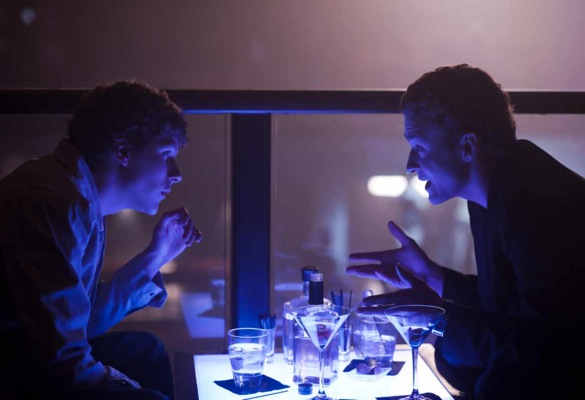
“This is OUR time” says Sean Parker, played by Justin Timberlake, in a key scene in THE SOCIAL NETWORK. This film is definitely the film of OUR time. It captures, with great skill and precision, the new world ahead of us, where the ‘nerds’ and ‘geeks’ control the social networks that we all use and that define our lives, and the old rules don’t apply. But some things are always the same.

An traditional tale of the American dream, complete with ambition, greed, betrayal, sex, and men of great vision, THE SOCIAL NETWORK is one of the seminal movies about the capitalist system, the way CITIZEN KANE was in the 1940s or NETWORK in the 1970s or even THE INSIDER in the 1990s. It works so brilliantly because, like the films referenced above, it brings top-level screenwriters with complete command of their craft in touch with accomplished, even masterful directors for a cinematic marriage made in heaven.

Sorkin’s signature dialogue sizzles against a perfectly controlled and beautifully photographed backdrop, courtesy of Fincher’s near-perfect directorial skills. The context, our modern, networked world, is so meta as to become one with the audience. Eisenberg’s Zuckberg, real or not, represents the Bill Gates-sation of the western world, where command of the right algorithm is enough to create one of the planet’s largest fortunes. This realisation, that technological capitalism, at the beginning of this new century, knows no bounds and takes no prisoners, is both frightening and exhilarating.

Most films I watch make a definite and concrete impression on me, and I can feel my opinion of them being formed as I see them - THE SOCIAL NETWORK unpacked itself in my brain little by little, like a Trojan virus slowly but completely dominating my movie-centric brain. I left the screening confused and baffled, and throughout the evening realised the different levels at which it had affected me. I am writing this review and I can sense more meanings rolling out even as I type.

This film will require multiple viewings, but I have no desire to see it anytime soon. A masterpiece that will be required viewing for decades to come, this is the film of the year. Move over, BLACK SWAN.

Uk Box Office 22-24 Oct

This weekend the sequel to one of the most profitable films of all time takes the top spot, PARANORMAL ACTIVITY 2, with an incredible per screen average of over £8K. The takings on this will only continue to roll in as this weekend is Halloween. On the other side of the audience segment, DESPICABLE ME picks up another £2.5 million in receipts. The action movie geared towards the post-40 generation, RED, gathered a respectable £1.6 million, proving not all blow 'em ups need to be geared towards teens. Further proof that adults like movies comes from THE SOCIAL NETWORK's healthy gross.

1- PARANORMAL ACTIVITY 2 (£3,756,788)(NEW)
2- DESPICABLE ME (£2,574,511) (2 WEEKS, TOTAL £7,569,824)
3- RED (£1,654,835) (NEW)
4- THE SOCIAL NETWORK (£1,531,098) (2 WEEKS, TOTAL £5,354,684)
5- THE LEGEND OF THE GUARDIANS (£747,374) (NEW)
6- ALPHA AND OMEGA (£644,522)
7- VAMPIRES SUCK (£528,625)(2 WEEKS, TOTAL £2,023,209)
8- EASY A (£275,450) (NEW)
9- LIFE AS WE KNOW IT (£256,749) (3 WEEKS, TOTAL £2,912,651)
10- WALL STREET: MONEY NEVER SLEEPS (£255,058) (3 WEEKS, TOTAL £3,695,078)

Thursday, 21 October 2010

Cut!


The Government, as we all know by now, has announced massive cuts in spending, including drastic and unprecedented cuts in the culture sector. Roughly speaking, this means cuts in the order of 50% of administrative cuts for the Arts Council, 30% of their overall funding, and 15% cuts in the regularly funded organisations (RFOs). The British Film Institute will experience 15% cut in funding. This comes on top of the abolition of the UK Film Council announced in the summer. What this means on the ground for arts and cultural organisations, to be honest, I don’t think anyone really knows yet. Of course, we all know it’s bad - it’s the extent of the damage done which is still unclear.

This comes within the context of cuts across the board in all sectors, and which is part of a wave of governments retreating throughout Western Europe. This consensus has been reached by the decision makers as their ‘cure’ for the excesses of the past decade, of which we were rudely awakened by the financial collapse of 2008. But not everyone around the world is adopting the same policies in order to deal with the hangover left by the bubble.

In the US, on top of the bank bailout, Obama injected 800 million dollars into the economy, in China, over 500 million was invested - in countries like Venezuela, Argentina and other Latin American countries, the world financial calamity has been avoided by huge government investment. This shows, simply, that there are other ways of handling this crisis, which incidentally, was brought on by none of the people affected by the alleged solution.

These cuts don’t only mean (from a cultural perspective) less money for the production and practice of arts, but also the space and the regard that as a society we give culture. In order for a developed nation like the UK to compete in a multipolar world where China, India and Brazil are investing tons of cash and energy in technology, culture and renewable energy, a post-industrial UK will have to rely on culture and technology in order to survive this global transition.

The only upside I can see from this is a political awakening of the cultural practitioners, a new understanding, after a decade of a sympathetic Labour government, that what happens politically and economically is completely and inexorably linked to the cultural sphere. We have to become better at talking to politicians, lobbying, protesting, legislating, and forming networks to find strength amongst each other. We can also make our organisations more profitable - finding ways to make cash without public support. That doesn't mean we shouldn't also appeal for that very support. We can double track our policies. The very survival of art and culture in this country might depend on it.

Monday, 18 October 2010

UK Box Office 15-17 Oct

Back to business then...the box office heats up in the UK with the release of product for all demographics: DESPICABLE ME for kids, THE SOCIAL NETWORK for adults and VAMPIRES SUCK for teens. The results for all three were pretty good:

1- DESPICABLE ME (£3,448,702)(New)
2- THE SOCIAL NETWORK (£2,100,648)(New)
3- VAMPIRES SUCK (£1,086,717) (New)
4- WALL STREET: MONEY NEVER SLEEPS (£675,343)(2 weeks, total £3,083,707)
5- LIFE AS WE KNOW IT (£623,028)( 2 weeks, total £2,261,269)
6- THE TOWN (£342,173)(4 weeks, total £4,441,668)
7- MADE IN DAGENHAM (£338,160) (3 weeks, total £2,557,018)
8- THE OTHER GUYS (332,026)(5 weeks, total £7,782,048)
9- DEATH & LIFE OF CHARLIE ST CLOUD (£314,401) (2 weeks, £1,297,876)
10- APLHA AND OMEGA (£177,072)(new)

Saturday, 16 October 2010

Valdivia: the end


In a few hours I depart on my 28 hour journey back to the UK. The Cine Sin Fronteras sessions concluded yesterday after we all presented our projects and received feedback and help from the professionals and other trainees. In the end I didn't manage to see any films, as our schedule and the amount of networking events to attend took over.

One of the most interesting aspects of this training was meeting film producers and distributors from Latin America and learning how they do their job. For example, Fiorella Moretti from Mantarraya Films (they produce and distribute films in Mexico) who works with acclaimed Cannes-winning Mexican filmmaker Carlos Reygadas (BATTLE IN HEAVEN, SILENT LIGHT) and who also releases arthouse films in Mexico like UNCLE BOONMEE. I also met Uruguayan producer Fernando Epstein, who produced WHISKY and GIGANTE (winner in Berlin this year). Florencia Schapiro from Lat-E, a sales agent and distributor, looks after the Argentinian arthouse market - check her blog out here.

The challenges they face are huge compared to the issues we face in Western Europe, in what is called 'mature markets': lack of audiences, lack of cinemas, lack of incentives, lack of cash, lack of any coherent cultural policy....these are all problems affecting Europeans, but on a very different scale.

As I mentioned in an earlier post, Venezuela seems like an exciting place because of the new laws that have been adopted recently which create incentives (very much in the model of Europa Cinemas) for cinemas to show national, Latin American and European cinema. There is also extensive funding for Venezuelan cinema, and hopefully we'll see the effects of these measures reaching our shores soon.

So thanks to our very lovely hosts in Valdivia who have been sweet from day one, and I shall definitely be returning as soon as I can...

I am heading back to Brighton with a ton of ideas and contacts for the CINE ESTELI project but also keen to get back to work at the Dukes, and catch up with all my favorite customers. See you there!

Thursday, 14 October 2010

Valdivia Day 3


As I write we are still in the middle of the training sessions that comprise the work of Cine Sin Fronteras, and tomorrow we present our projects. The days are long and hard, but very productive - and what's the point in sleeping when you travel across the world?

I've made some important contacts that will hopefully help me take the CINE ESTELI project forward, including key funding bodies and festivals. I've also heard some really interesting presentations, including one from Paula Astorga, who is the head of the Cineteca in Mexico City. She talked in depth about audience segmentation and it reminded me of something that I think I already knew: that understanding who your audience is key.

A company called BRAZUCA also presented the work they do in Universities in Brazil, which is much more sophisticated than I expected to find in South America, but that says more about my poorly informed expectations than about the level of the market down here.

Based on my very limited experience and knowledge of Chile, I can categorically say (without trying to sound like a suck up to my gracious hosts) that Chileans are the most polite collection of people I have ever encountered in my travels.

Tonight we finally see a film, Sebastian Silva's GATOS VIEJOS (OLD CATS). Full review to follow tomorrow.

Wednesday, 13 October 2010

Valdivia, Day 2


Would more cinemas increase admissions? This very theory was presented by Patrice Vivancos, a media expert/consultant yesterday at our first full day of work for the CSF workshops. Using the US market as a model, where there is a screen per each 7,800 inhabitants (and consequently has the highest visit per capita worldwide), he argues that if the industry wants more customers, it needs to start re-opening or building new cinemas. This sparked quite a debate, as the US model is not seen as particularly an enlightened one by arthouse operators, particularly since its the French model that is being presented here as the panacea to all our problems.

The French system taxes all movies, TV and any other audiovisual commercial activities to the tune of half a billion euros each year and then reinvests this money in their national industry. This is a hugely privileged position that few countries can afford, if only because 21st century WTO rules prohibit such protectionism. But in another sign that the world is changing and the Washington consensus is not so consensual, Venezuela have just passed a law (our Venezuelan colleagues tell me) that makes it a legal requirement for multiplexes to play national cinema, and injects a lot of money into production, distribution and exhibition of national and Latin American cinema.

After the sessions we were given a tour of Teatro Cervantes, a 1940s theater that is closed permanently but re-opened each year just for the Festival dates. They have a collection of ancient projectors and were busy making the space safe and ready for audiences when the fest opens tomorrow. They clearly had heard of my obsession with historic cinemas.

As always with these events, the real reward is in meeting likeminded colleagues doing the same work in a different country - with different markets, cultures, and laws. Some of the best debates about the future of arthouse happened over a quinoa risotto (a local speciality).